


Industrial activity across manufacturing, logistics, energy, metals, and infrastructure is completely relying on speed, precision, and safety.
With rising production demand and facilities becoming complex, efficient material handling has become a core operational requirement. The ability to move heavy loads repeatedly and safely has a direct impact on productivity, compliance, and workforce protection.
Within this context, industrial cranes serve as essential infrastructure in contemporary industrial environments. They are not standalone machines, but engineered systems that support intelligent material movement, reduce operational risk, and enable facilities to scale safely and efficiently.
Let’s understand more about them in depth.
What Are Industrial Cranes?
Industrial cranes are engineered lifting systems designed to handle loads beyond the capability of conventional handling equipment. They are built for repetitive use, demanding duty cycles, and environments where precision and reliability are critical to daily operations.
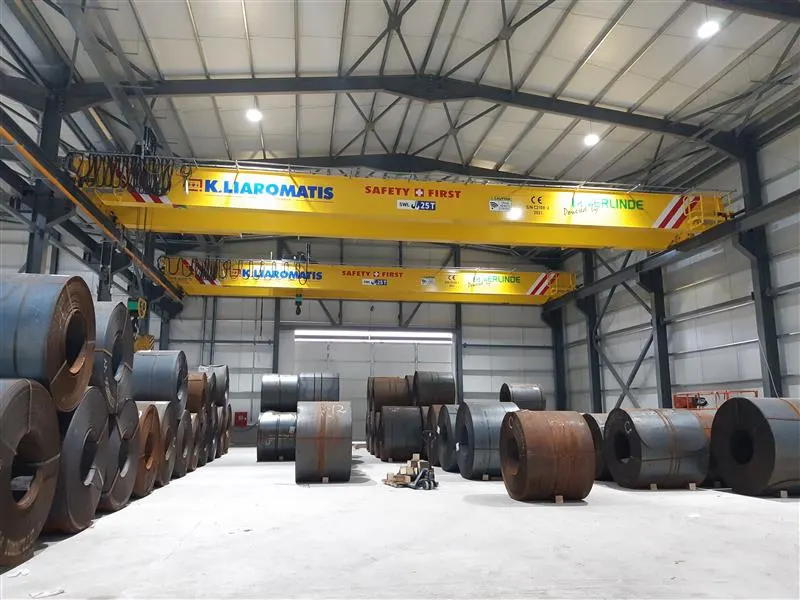
Industrial cranes can be broadly categorised into:
- Workstation lifting systems
- Overhead cranes
- Gantry and jib cranes
- Open winch or process cranes.
Each category is engineered around specific load capacities, operational frequencies, and spatial requirements. This allows lifting systems to be precisely matched to industrial applications rather than applied as generic solutions.
Let’s understand each of these categories in detail.
Common Types of Industrial Cranes and Their Applications
1. Workstation Lifting Systems
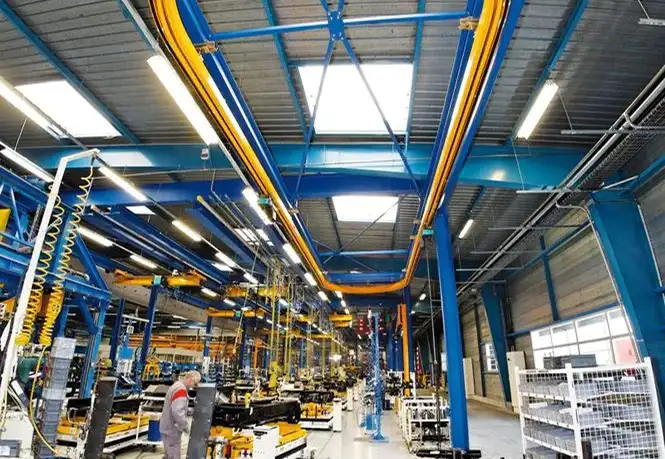
Workstation lifting systems are commonly used in assembly lines and repetitive production tasks.
Their primary focus is ergonomic load handling, enabling operators to position components accurately while reducing physical strain.
These systems are highly adaptable and can be reconfigured as production layouts or workflows change, making them suitable for automotive, electronics, and precision manufacturing environments.
2. Overhead and Gantry Cranes
Overhead cranes form the backbone of lifting operations in factories, warehouses, and industrial halls.
By utilising vertical space, they allow heavy loads to be moved efficiently without obstructing floor-level activities. These systems are widely used for medium to heavy lifting across production and storage environments.
Within this category, EOT Cranes are commonly deployed where controlled, repeatable movement across long spans is required. Similarly, top-running cranes are widely adopted in industrial buildings designed to support higher loads through runway beams mounted on the structure itself.
Gantry cranes complement overhead systems by offering flexible lifting in areas where building support structures are limited or where outdoor operation is required.
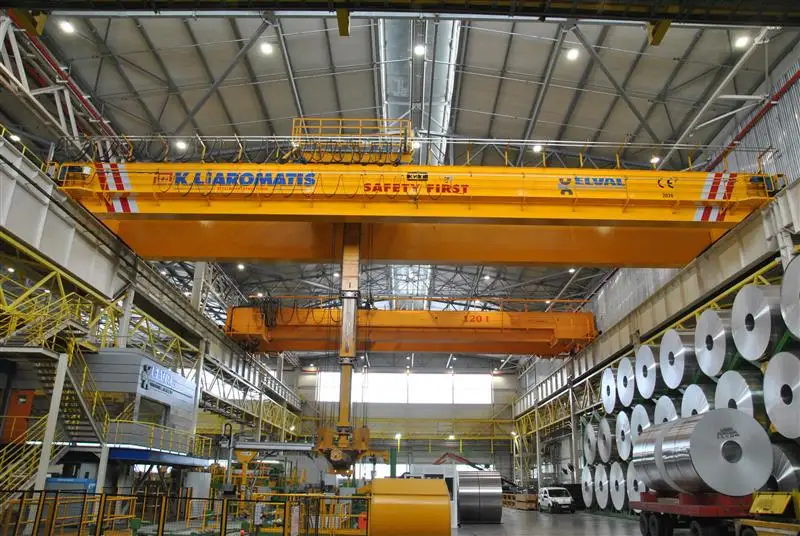
3. Process and Open Winch Cranes
Process and open winch cranes are designed for industries with extreme lifting demands, such as metals production, energy generation, and waste-to-energy facilities.
These cranes handle very high loads and operate under continuous duty cycles, often in environments where precision is non-negotiable. Their design supports sensitive load handling while maintaining the robustness required for heavy industrial processes.
For a better understanding of different types of cranes, here’s a tabular summary of each of them:
Crane Type | Best Use Case | Key Advantage |
Flexible Lifting Systems | Light load handling in assembly lines and workstations | Highly adaptable, modular, and easy to reconfigure |
Overhead (EOT) Cranes | Heavy material handling across factories and industrial facilities | Supports efficient, continuous material flow in demanding industries |
Top-Running Cranes | Facilities requiring high-capacity lifting across large spans | Suitable for complex lifting needs with strong structural support |
Gantry Cranes (Semi/Full) | Outdoor areas or sites without building support structures | Independent structure allows flexible deployment and mobility |
Jib Cranes | Localised lifting at individual workstations or production areas | Improves precision and efficiency in repetitive tasks |
Verlinde Equipment (Hoists & Components) | Supporting lifting operations within crane systems or standalone use | Wide range of lifting components enabling customised solutions |
However, as industrial lifting requirements are growing, mechanical strength alone is no longer sufficient. This shift has pushed industrial cranes into digitally enabled assets that actively support decision-making, risk reduction, and process optimisation. Let’s explore how.
Smart, Modern Technology and Intelligent Lifting
The way industrial cranes are improving in operations and design reflects the integration of smart crane technology in their manufacturing.
Modern lifting systems now incorporate software-based control features that enhance their working efficiency along with safety.
Technologies such as sway control, hook centring, and automated load positioning help reduce operator effort while minimising the risk of load instability.
By optimising crane movements, lifting cycle times shorten automatically, and mechanical wear also reduces. This leads not only to productivity gains but also to extended equipment lifespan.
Furthermore, remote monitoring platforms expand the capabilities of industrial cranes. These systems collect and analyse operational data, and enable real-time performance tracking and condition monitoring, allowing operators to identify potential issues before they lead to downtime.
Safety, Maintenance and Lifecycle Performance
Safety remains a foundational consideration in industrial lifting operations.
Preventive maintenance programs and regular inspections are essential to ensure compliance with stringent safety regulations, particularly in highly regulated markets such as Germany, Sweden, and the UAE.
The modern crane lifecycle should emphasise long-term reliability rather than short-term performance. This is possible with:
- Proactive maintenance strategies that help identify wear patterns, optimise component replacement schedules, and reduce the risk of unplanned failures.
- Upgrading cranes with evolving operational demands to meet new capacity, automation, or safety requirements, without heavily relying on incompetent systems.
This approach improves cost efficiency by extending equipment service life while maintaining consistent operational performance.
For industrial operators, this translates into predictable maintenance planning and improved Return On Investment (ROI)
Sustainability and the Future of Industrial Cranes
Sustainability is becoming a defining factor in industrial equipment design.
Energy-efficient motors, optimised drive systems, and lightweight components help reduce power consumption without compromising the cranes’ lifting capacity.
Furthermore, lifecycle optimisation supports sustainable industrial operations by minimising waste and extending asset usability.
While considering the future of industrial cranes
Intelligent lifting systems play an increasingly important role in smart factories, where digital integration enables energy monitoring, process optimization, and reduced environmental impact.
As industries across Europe and the Middle East transition toward more sustainable operations, industrial cranes will continue to evolve as enablers of responsible growth.
Conclusion
Industrial cranes play a central role in modern production and infrastructure for providing safe, precise, and efficient material handling across demanding industries.
By combining robust design with intelligent control systems, today’s cranes support higher productivity, reduce operational risk and improve long-term reliability.
As digitalisation, automation, and sustainability continue to shape industrial operations, the importance of well-engineered lifting systems becomes even more pronounced. Reliable EOT and overhead crane solutions, supported by lifecycle-focused maintenance and modernisation, help facilities remain resilient, compliant, and future-ready.
In this context, experienced providers such as K. Liaromatis, with proven expertise in EOT cranes and top-running crane systems, play a critical role in supporting industries with lifting solutions that align with safety standards, operational efficiency, and evolving industrial requirements.
Subscribe To Our Newsletter
Stay updated with our latest insights, news, and exclusive updates!